The United Nations has sounded the alarm as landmine deaths rise amid funding cuts to demining programmes.
Landmine deaths surge worldwide amid UN demining funding cut
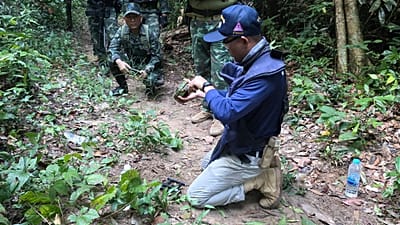
Deactivating a mine
-
Copyright © africanews
AP/AP
International experts meeting in Geneva say the legacy of conflicts old and new continues to kill and maim civilians on a near-daily basis.
The UN Mine Action Programme (UNMAS) said that although mine clearance work in the Occupied Palestinian Territory and Sudan is currently reasonably well funded, the situation in Afghanistan and Nigeria was dire.
Its representative in Geneva, Christelle Loupforest, said programmes in the two countries and Ethiopia face closure by March without fresh donor support.
In Sudan, the situation remains deeply concerning for stretched landmine clearance teams who fear for the 1.5 million civilians who have returned to Khartoum.
The capital was the initial epicentre of the ongoing conflict between the Sudanese Armed Forces and paramilitary Rapid Support Forces (RSF).
Just five UNMAS clearance teams are at work in Sudan today and “all of them are in Khartoum, because the need is so big there” said its chief in Sudan, Sediq Rashid.
He added that the UN was deeply concerned about the situation in the city of al-Fasher which was besieged for more than 500 days.
“Even now, you know [the shelling] has not completely stopped. And there are reports of the presence of landmines as well, so it's very concerning and the access is a big challenge to that area,” he said.
In Nigeria, demining teams worry that with camps for displaced communities closing down, people risk returning to areas where lethal unexploded ordinances may be hidden from view.
“Unfortunately, our analysis shows that 80 per cent of all of the civilian casualties are happening in 11 of the 15 areas of return,” said UNMAS Chief of the Mine Action Programme in Nigeria, Edwin Faigmane.
In response, UNMAS trained the Nigerian security forces, police and civil defence workers on risk education in often unstable areas that are described as “hard-to-reach”.
Experts stressed that mine action programmes, often viewed as long-term recovery initiatives, are in fact emergency humanitarian interventions that save lives.