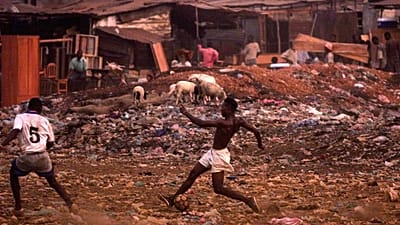
In Conakry’s densely populated Dar Es Salam neighborhood, residents say life has become a daily struggle for breath. For years, families living next to the towering municipal trash dump have endured thick, toxic smoke from the constant burning of waste. Many now fear the long-term health consequences as the dump continues to expand, overshadowing the community.
Toxic smoke chokes Conakry community as residents plead for government action
Cleared
-
Copyright © africanews
BRENNAN LINSLEY/AP
For Daouda Sylla, the damage is already deeply felt. “I live in a very distressing condition,” he said in Susu. “Simply sitting affects my lungs as if a fire was burning inside. Even more so when I take a walk of 20 to 30 meters; it becomes a real problem.” Sylla describes sleepless nights spent coughing, with only cold water offering momentary relief. Yet when he visits the hospital, doctors warn him to stop smoking or drinking. “But I don’t smoke cigarettes, and I don’t drink either,” he insisted.
Like Sylla, many in Dar Es Salam blame the dump, where trash fires fill the air with acrid fumes that settle over homes, schools, and nearby businesses. The site has grown so large over the years that its mountain of waste now dominates the horizon.
Among the most vulnerable are children, whose developing lungs are particularly susceptible. Mamadama Bangoura says her young son Djibril has been chronically ill since he was six months old. “This child is often disturbed by the smoke coming from the dump. That’s what exhausts him,” she said. “Every time he goes outside and breathes in the air, he first suffocates and then has a crisis that lasts two days. When that happens, we are forced to give him oxygen. He doesn’t even go outside anymore.”
Health experts warn that the long-term consequences for the community could be severe. At a local clinic, pulmonologist Nyan Balamoun Gobou Tokpa says the pollution is contributing to respiratory diseases, including pneumonia and chronic obstructive pulmonary disease. “In the long term, the local population may develop bronchopulmonary cancer,” he said. The dump, he added, “is slowly killing the nearby population.”
The crisis unfolds as Guinea’s military leader, Gen. Mamadi Doumbouya, continues to promote an agenda focused on national development and infrastructure upgrades following his 2021 coup. In Conakry, many youths have applauded recent road repairs in neighborhoods long neglected by previous governments. Doumbouya has also championed “Simandou 2040,” an initiative built around revenue from Guinea’s vast iron ore deposits, which he vows will usher in greater prosperity.
But in Dar Es Salam, residents say prosperity means little if they cannot breathe. They are calling on Doumbouya to act swiftly. “We demand that the general come to our aid and help us remove this dump from Dar Es Salam. Because today, we are suffering,” said Nana Rachel Bangoura, a representative of the Citizen Collective for a Healthy Environment in Dar Es Salam. Standing amid heaps of smoldering waste, she added, “We are tired of living in Dar Es Salam. But we have our homes in Dar Es Salam. We cannot leave.”
For families like Sylla’s and Bangoura’s, the hope now is that national promises of change will reach the places where inhaling clean air has become a luxury—and survival depends on an urgent response.