




Guinea
Two leaders of a collective that organised demonstrations that left five people dead, according to the justice minister, were charged and imprisoned after appearing on Monday before an examining magistrate at a court in the suburbs of Conakry.
On Thursday and Friday, bloody demonstrations against the junta, banned by the authorities, resulted in "five deaths many injured civilians and soldiers and significant material damage," according to a statement Monday by former prosecutor Alphonse Charles Wright.
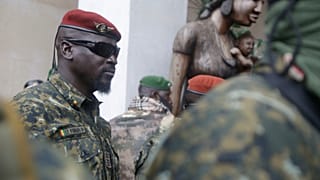
The junta chaired by Colonel Mamady Doumbouya, who overthrew President Alpha Conde on 5 September, requisitioned the army "for the maintenance of order", and proceeded Friday and Saturday to dozens of arrests.
Among them, those of Oumar Sylla alias Foniké Mangué and Ibrahima Diallo, two leaders of the National Front for the Defence of the Constitution (FNDC), a coalition of parties, trade unions and civil society organisations behind the demonstration.
The two men, heard in the afternoon by an investigating judge, were charged with "participation in a prohibited gathering, looting, destruction of public and private property, assault and battery" and imprisoned in the civil prison of Conakry.
Saïkou Yaya Barry, executive secretary of the Union of Republican Forces (UFR) of former Prime Minister Sidya Touré, was also charged and imprisoned. Nine young people were also prosecuted for the same offences.
The prosecutor asked on Monday for a six-month suspended prison sentence and a fine of 500,000 fg (60 euros) against each of them. The FNDC denounced "yet another provocation and instrumentalisation of justice" by the junta.
The collective, which had called for another protest movement on 4 August throughout the country to denounce the "unilateral management of the transition" by the junta, suspended the demonstrations on Saturday for a week "at the express request" of the head of state of Guinea-Bissau Umaro Sissoco Embalo, current president of the Economic Community of West African States (ECOWAS).
ECOWAS also called on Monday in a statement "the Guinean authorities, the political class and civil society to engage in an inclusive dialogue to defuse the tension and agree on a timetable and reasonable modalities for the peaceful restoration of constitutional order.
The day before, the "Forces vives de la nation", a coalition of political parties, trade unions and civil society organisations, also demanded "the immediate opening of a framework for inclusive dialogue" and threatened new demonstrations from 15 August 2022 throughout the national territory.

01:27
Tanzania still haunted by deadly election violence one year on
01:00
Israel: protesters demand Arab-Jewish unity government after election
01:10
No clear winner in Israel's first election since the 2023 Hamas attack
01:49
Senegal's finance committee to review revised budget key to IMF deal
01:00
Israel: opposition supporters celebrate narrow lead in exit polls
01:00
Portugal: Lisbon housing crisis sparks protest outside parliament