



Somalia
Somaliland’s decision to ban social media during its election on November 13 has been challenged by the country’s human rights body at the Supreme Court.
The Somaliland Human Right Centre submitted a petition to the court to halt the move by the National Electoral Commission (NEC) which said on Friday that the shutdown will be observed from Monday until the results are announced.
The NEC said it was necessary to block social media to avoid the spread of fake news and rumours.
The court’s ruling is expected by Monday ahead of the opening of polls.
The self-declared independent state of Somaliland ended its campaign on Friday ahead of its third elections on Monday.
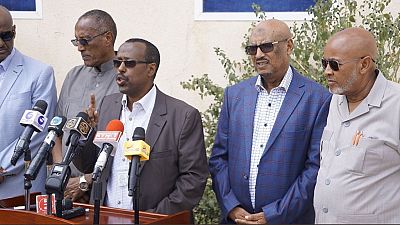
The three candidates are former minister Muse Bihi Abdi of the ruling KULMIYE (Peace, Unity and Development Party); veteran politician Faisal Ali Warabe of UCID (Justice and Welfare Party); and then the former speaker of the House of Representatives Abdirahman Mohamed Abdullahi Irro of Waddani (National Party).
They marched together through the capital Hargeisa on Saturday holding hands to depict unity and call for peace as the country goes to the polls. They addressed the media after a meeting with the Electoral Commission.
Today in #Hargeisa. This is how we do it in #Somaliland #SLelection2017#SomalilandVotes
— Khadar Mariano (APuntite) November 11, 2017NEC2017pic.twitter.com/j1dOI7u1HE
This election is touted to be the first incident-free polls to be held in the Horn of Africa.
Out of the about 4 million Somaliland population, 704, 089 registered voters are expected to elect the new president. There are 1,642 polling stations in the 21 constituencies across the six regions of the country.
The country will be the first in Africa to use the iris-recognition biometric voter registration system.
A team of 60 international election observers from 24 countries have been deployed to the country by the international election observation mission (EOM) funded by the British government.
Somaliland’s decision to block social media follows those of Uganda, Congo, Chad, Gabon, Niger, and Gambia where internet connection was blocked during their elections last year. The blockade did not reduce controversies during those elections.
Countries such as Ghana, Zambia, and recently Rwanda, Angola, Kenya and Liberia kept their internet active and were not threatened by fake news.
NEC Chairperson Abdukadir Iman Warsame said everything is ready for the election on Monday.



00:43
Somaliland opens embassy in Jerusalem after historic Israeli recognition
01:37
Somaliland president visits Jerusalem in defiance of Mogadishu
01:17
Somali President says Israel exploiting row with Somaliland
01:02
Somaliland to open first-ever embassy in Jerusalem
01:25
Somaliland marks independence day with renewed push for international recognition
01:03
Cape Verde opposition wins parliamentary elections