



Ethiopia
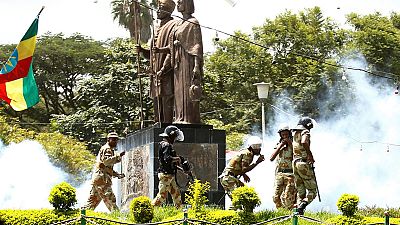
A western diplomat in Ethiopia is concerned over restrictions imposed on their movement by the Ethiopian government. According to the unnamed diplomat the move indicates that the regime was set to impose “repressive measures” as part of a recently announced state of emergency.
The government on Monday issued new guidelines around the October 9 state of emergency. One of the directives was a ban on foreign diplomats travelling more than 40km (25 miles) outside the capital, Addis Ababa, “for their own security.”
‘‘This is a state of emergency and we expect repressive measures. But we also expect an opening of the political space for the opposition as stated by the president in front of the parliament. This is not what seems to be happening,” the diplomat told AFP.
The government through the Prime Minister, Hailemariam Desalegn, had promised last week that it will open up the political space in the country. He also assured the European Union (EU) that deadly security crackdown was going to be investigated.
The German chancellor, Angela Merkel, on a visit to the country last week, tasked the government to allow protests. She added that the security agencies should be proportionate in their response to protests.
The Danish ambassador to Ethiopia, Mette Thygesen, had disclosed last week that the Ethiopian government had failed to give concrete promises on when mobile internet and social media service will be restored.
Under the new restrictions, the government has tightened access to online communication and to some extent the traditional media outlets.
Physically publishing and distributing documents, demonstrations, showing protest gestures as well as republishing and sending media materials for publication have been banned.
Security forces have been empowered to monitor, search and arrest anyone who violates the regulation while giving them power to defend themselves from any threat or attack.
The government has been experiencing its worst protests in recent years in the Oromo and Amhara regions. These protests have led to mass death of protesters as a result of security crackdown.
Whiles the opposition accuses government of being repressive and denying them political freedom. The government denies the allegation and says “foreign enemies” in Eritrea and Egypt are fuelling the unrest which has killed hundreds of people since November 2015.

00:56
Ethiopia's coffee exports fetch more than $870 million
02:12
Up to 50,000 Ethiopians flee to Kenya as clashes escalate
02:31
Ethiopia: Reusable sanitary pads help girls break the silence around menstruation
01:09
Thousands of Ethiopian Jews mark holy day of Sigd in Jerusalem
01:00
Philippines: 'Trump out!' Women rally ahead of ASEAN summit
01:00
Netherlands: Sea of red fills Amsterdam streets in Gaza protest